
Key findings
- Of the five tests since the law took effect, two were met (fiscal 2022 and 2024) and three were missed (fiscal 2023, 2025, and 2026) (Office of State Budget Director letters; fiscal 2022 per news reporting).
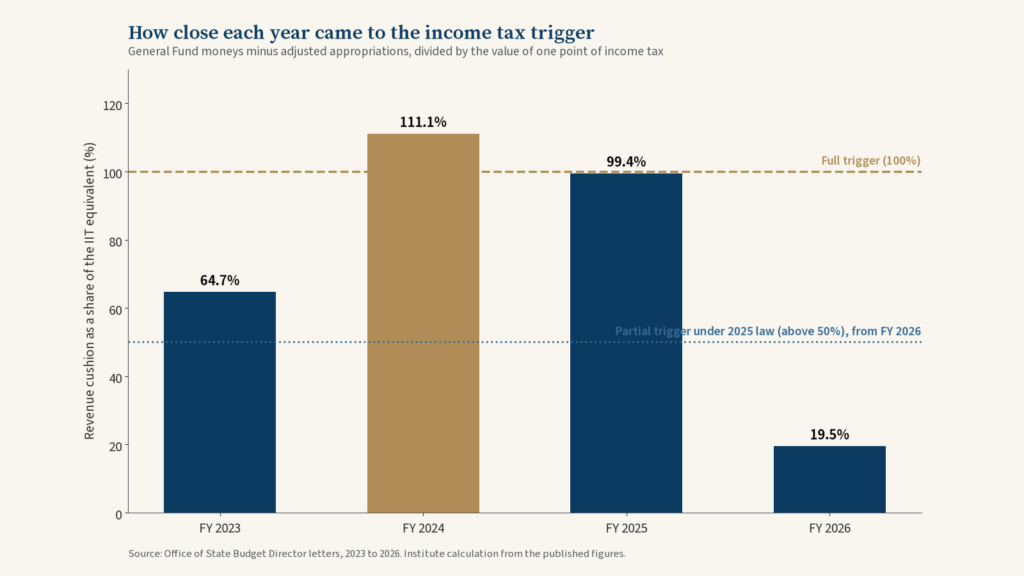
- In fiscal 2026, General Fund moneys covered adjusted appropriations plus about 19 percent of the IIT equivalent, below the 50 percent needed for the smaller quarter point cut (Institute calculation from the September 4, 2026 letter).
- The rainy day fund condition has not been the constraint. The fund equaled 26.1 percent of General Fund moneys at the end of fiscal 2026, against a 10 percent floor (published figure).
- From the fiscal 2028 test onward, a 2025 law allows cuts of 0.1 to 0.5 points depending on the size of the cushion, which makes smaller steps more likely (statutory text).
- The individual income tax rate is 3.5 percent and, under the statute, stays at that level for 2027 and 2028 unless the law itself is changed (statutory text and letters).
Kentucky’s income tax trigger is a yearly test, set in KRS 141.020, that decides whether lawmakers may lower the individual income tax rate. The test was not met for fiscal 2026. Under the statute, the rate stays at 3.5 percent for 2028 unless lawmakers change the law itself.
Summary
Since 2022, Kentucky law has tied cuts in the individual income tax rate to a yearly test of state finances. Each September, the State Budget Director reports whether the fiscal year just ended met two conditions: a rainy day fund of at least 10 percent of General Fund moneys, and enough revenue to cover appropriations plus the value of one percentage point of income tax. If both are met, the General Assembly may vote to lower the rate. Nothing happens automatically.
This brief explains each part of the test, reports what the last four tests found, and sets out the options lawmakers have in 2027 with their trade-offs. The Institute takes no position on them.
What question does this brief answer?
How does the trigger work, what has it found, and what can the 2027 General Assembly do about it?
The question matters now because the budget director’s report of September 4, 2026, found a shortfall of about $1.2 billion against the full test, the largest of the four years reported since fiscal 2023. The 2027 session convenes January 5. For a news account of that report, see the Ledger’s analysis of the Kentucky income tax trigger.
How does the two part test work?
Both conditions must be met at the end of a fiscal year.
Condition 1: the rainy day fund. The balance in the Budget Reserve Trust Fund must be at least 10 percent of General Fund moneys for that year.
Condition 2: the revenue cushion. General Fund moneys must be at least equal to “GF appropriations” plus an amount tied to the “IIT equivalent.”
The statute defines each term:
- GF moneys: receipts deposited in the General Fund, excluding certain tobacco moneys.
- GF appropriations: General Fund appropriations, minus continuing appropriations, appropriations to and from the Budget Reserve Trust Fund, and certain lump sum payments to state retirement systems above required contributions.
- IIT equivalent: the revenue one percentage point of income tax raised that year. It is computed by dividing actual income tax receipts by the average rate in effect during the fiscal year.
If the conditions are met, the General Assembly “may take action” to lower the rate. If they are not met, or lawmakers do not act, the Department of Revenue keeps the existing rate. The statute adds that the annual process “shall continue until the income tax rate is zero.”
How large a cut can the test allow?
It depends on the year. The 2025 law created smaller steps.
| Fiscal years tested | Cushion needed (share of IIT equivalent) | Rate cut allowed |
|---|---|---|
| 2022 to 2025 | 100% | 0.5 point |
| 2026 and 2027 | more than 50% but less than 100% | 0.25 point |
| 2026 and 2027 | 100% | 0.5 point |
| 2028 onward | 20% to 39% | 0.1 point |
| 2028 onward | 40% to 59% | 0.2 point |
| 2028 onward | 60% to 79% | 0.3 point |
| 2028 onward | 80% to 99% | 0.4 point |
| 2028 onward | 100% | 0.5 point |
What have the tests found?
One pass and three misses in the four years with published letters.

| Fiscal year | GF moneys | Threshold (full test) | Margin | Result |
|---|---|---|---|---|
| 2023 | $15.148 billion | $15.583 billion | minus $435 million | Not met |
| 2024 | $15.571 billion | $15.420 billion | plus $151 million | Met |
| 2025 | $15.703 billion | $15.711 billion | minus $7.6 million | Not met |
| 2026 | $15.976 billion | $17.171 billion | minus $1.195 billion | Not met |
Measured as a share of the IIT equivalent, the cushion was about 65 percent in fiscal 2023, 111 percent in fiscal 2024, 99 percent in fiscal 2025, and 19 percent in fiscal 2026, by the Institute’s calculation. The fiscal 2025 result would have qualified for a quarter point cut had the 2025 amendment applied to that year.
According to Kentucky Public Radio, the test was also met for fiscal 2022, the first year after the law passed.
How has the rate changed?
From 5 percent to 3.5 percent in four years, in three steps.
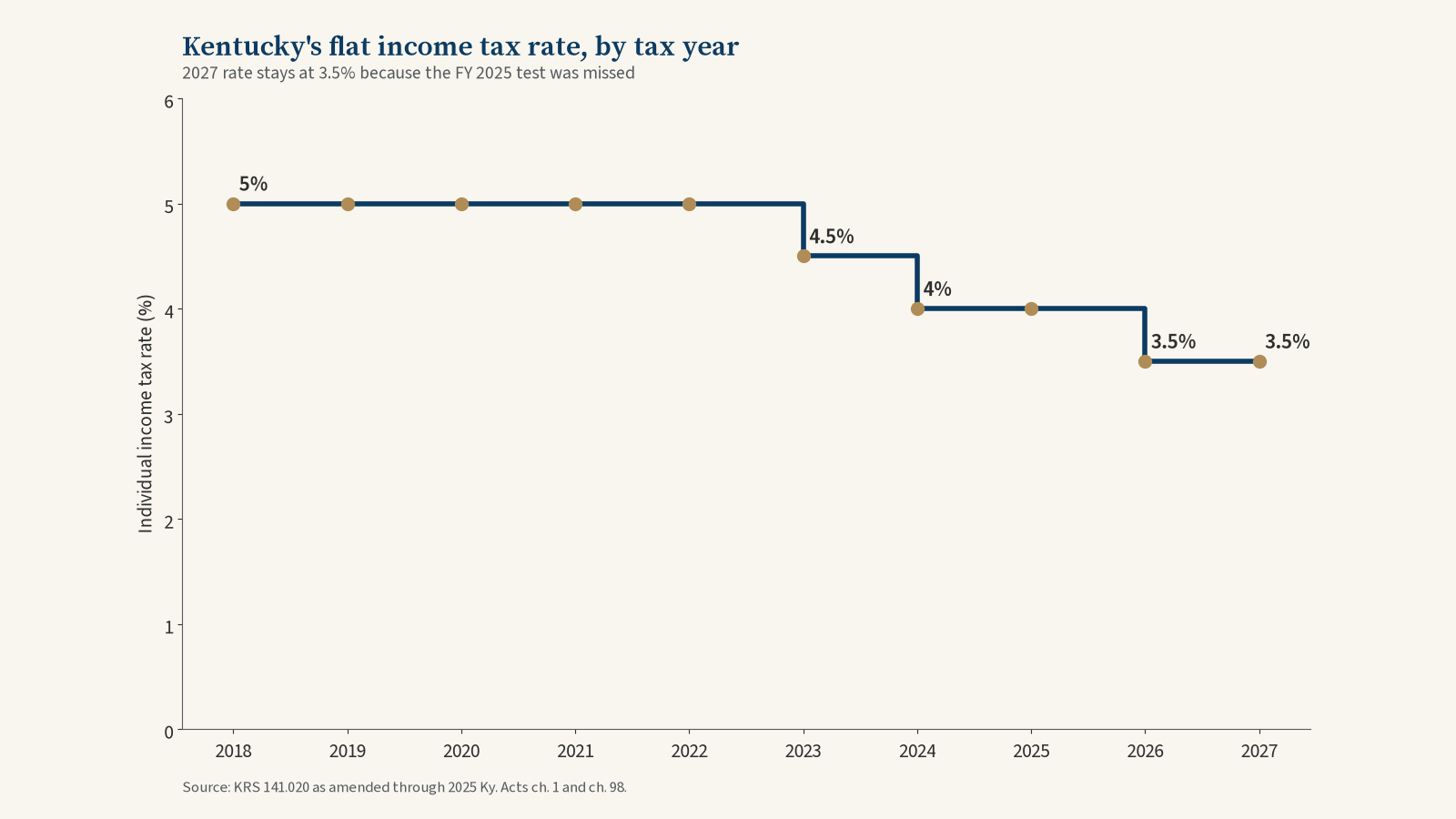
- 5 percent for 2018 through 2022
- 4.5 percent for 2023, set by the 2022 law that created the trigger (2022 Ky. Acts ch. 212, House Bill 8)
- 4 percent for 2024 and 2025, after the fiscal 2022 test
- 3.5 percent from 2026, after the fiscal 2024 test (2025 Ky. Acts ch. 1)
Because the fiscal 2025 and fiscal 2026 tests were not met, the statute holds the rate at 3.5 percent for 2027 and 2028.
What are the options for 2027?
Lawmakers have four broad approaches. Each has trade-offs. The Institute does not recommend among them.
1. Keep the statute as it is.
The next test covers fiscal 2027 and must be reported by September 5, 2027. If met, the 2028 session could act on a cut for 2029.
- For: predictable rules; cuts happen only when revenue and reserves support them, which is the design Senate budget chair Chris McDaniel has described as responsible.
- Against: slower progress toward the statute’s stated end point of a zero rate; results can swing on accounting items in the test, as fiscal 2026 showed.
2. Change the conditions. Lawmakers could adjust the bands, the definition of GF appropriations, or the reserve requirement.
- For: can align the test with lawmakers’ goals; the 2025 change already moved in this direction.
- Against: easier conditions mean thinner cushions when cuts take effect; changes to definitions can be hard for the public to follow.
3. Cut the rate by separate legislation.
The General Assembly can amend the rate directly, whatever the test shows. Kentucky Public Radio reported that one House member argued for this approach in 2025; it did not advance in the 2026 session.
- For: faster rate reductions.
- Against: sets aside the safeguard the trigger was built to provide; revenue effects would need to be absorbed in the budget.
4. Replace the flat rate or repeal the trigger.
Two 2026 House bills, House Bill 13 and House Bill 152, would have created graduated rates and removed the reduction procedures. Both were referred to the Appropriations and Revenue Committee and did not advance.
- For: returns rate decisions to ordinary legislation; graduated rates change who bears the tax.
- Against: reverses a policy direction the General Assembly has followed since 2022; could raise taxes for some filers, depending on the rates chosen.
For how the 2027 session is organized, including its deadlines and veto period, see the Ledger’s guide to the Kentucky General Assembly 2027.
One procedural point applies to all four. In odd numbered years, Section 36 of the Kentucky Constitution requires a three fifths vote of all members elected to each chamber for any bill raising revenue or appropriating funds. Whether that rule applies to a given tax bill depends on its content.
For the Institute’s work on state institutions and public finance, see the Center for Government and Civic Institutions.
Sources
- Kentucky Revised Statutes, KRS 141.020, effective June 27, 2025
- Legislative Research Commission, 25RS House Bill 775 (2025 Ky. Acts ch. 98)
- Office of State Budget Director, Fiscal Year 2026 letter, September 4, 2026
- Office of State Budget Director, Fiscal Year 2025 letter, August 15, 2025
- Office of State Budget Director, Fiscal Year 2024 letter, August 21, 2024
- Office of State Budget Director, Fiscal Year 2023 letter, August 14, 2023
- Joe Sonka, Kentucky Public Radio, Kentucky misses budget trigger for income tax cut by more than $1 billion, September 4, 2026
- Legislative Research Commission, 26RS House Bill 13 and 26RS House Bill 152
- Kentucky Constitution, Section 36
Methodology
This brief is based on the text of KRS 141.020 as in effect from June 27, 2025, and on the Office of State Budget Director's letters for fiscal years 2023 through 2026, which report each item in the test. Figures from the letters are reported as published, rounded for readability.
The Institute calculated the cushion as a share of the IIT equivalent by dividing each year's difference between General Fund moneys and adjusted appropriations by that year's IIT equivalent. Year to year changes are simple subtractions from the published letters. The fiscal 2022 result is taken from Kentucky Public Radio's reporting, because the Institute did not obtain the fiscal 2022 letter.
Every figure was checked against its published source before release. Bill status is from Legislative Research Commission records.
Limitations
The brief describes how the test works and what it found. It does not estimate the economic or revenue effects of any rate change, and it does not forecast whether the fiscal 2027 test will be met.
The budget director's letters report the amounts used in the test but not the reasons for changes in them, such as changes in appropriations to and from the Budget Reserve Trust Fund. The brief does not interpret those reasons.
Options are described at the level of approach. Specific bills filed for the 2027 session may differ, and their effects would need separate analysis.
Funding and disclosures
Prepared by Institute staff. No outside sponsor is associated with this publication.
Corrections and updates
None
Suggested citation
Bert Foster, Commonwealth Governance and Policy Fellow. 2026. "How Kentucky’s Income Tax Trigger Works: A step by step guide to KRS 141.020, what the last four tests found, and the choices before the 2027 General Assembly." Policy Brief. Louisville, KY: The Commonwealth Initiative. https://commonwealthinitiative.org/research/kentucky-income-tax-trigger-explained/