
Kentucky missed its income tax trigger for the fiscal year that ended June 30, 2026, and not by a little. General Fund moneys came in about $1.2 billion below the level needed for a half point cut, and about $453 million below the lower bar for a quarter point cut. Under the trigger statute, the individual income tax rate stays at 3.5 percent for 2028.
That finding comes from a September 4, 2026 letter from State Budget Director John T. Hicks to the co-chairs of the Interim Joint Committee on Appropriations and Revenue.
The letter is short, and every number in it matters. This piece walks through it.
What is Kentucky’s income tax trigger?
It is a two part test, written into KRS 141.020 in 2022, that decides each year whether lawmakers may lower the individual income tax rate.
The test looks back at the fiscal year that just ended. Both conditions have to be met:
- The Budget Reserve Trust Fund, the state’s rainy day fund, must hold at least 10 percent of General Fund moneys at year end.
- General Fund moneys must be at least as large as General Fund appropriations plus the “IIT equivalent,” the revenue that one full percentage point of income tax would raise.
The second condition is the hard one. It asks whether the state could have paid for everything it appropriated even with a tax rate a full point lower. If so, the statute allows a half point cut.
The cut is not automatic. The statute says the Department of Revenue “shall not implement an income tax rate reduction without an action by the General Assembly.”
The trigger opens a door. Lawmakers still have to walk through it.
What did the September 2026 letter find?
General Fund moneys of $15.98 billion fell short of both thresholds. The rainy day fund condition was met easily.

Here are the figures from the letter, rounded:
| Item | Fiscal year 2026 |
|---|---|
| General Fund moneys (receipts, excluding tobacco) | $15.976 billion |
| General Fund appropriations, as adjusted under the statute | $15.687 billion |
| IIT equivalent (one percentage point of income tax) | $1.484 billion |
| Threshold for a 0.5 point cut (appropriations plus full IIT equivalent) | $17.171 billion |
| Shortfall against that threshold | $1.195 billion |
| Threshold for a 0.25 point cut (appropriations plus 50% of IIT equivalent) | $16.429 billion |
| Shortfall against that threshold | $453 million |
| Budget Reserve Trust Fund balance at year end, plus closeout actions | $4.162 billion (26.1% of General Fund moneys) |
The rainy day fund was more than two and a half times the 10 percent floor. Savings were not the problem. The revenue test was.
Why did Kentucky miss by so much this time?
The biggest change between the two years was in one adjustment the statute makes to appropriations.
Set the 2026 letter beside the one from August 15, 2025, and one line stands out. The test starts from total General Fund appropriations and then subtracts several items the statute excludes. One of them is appropriations to and from the Budget Reserve Trust Fund.
| Line in the letter | Fiscal 2025 | Fiscal 2026 | Change |
|---|---|---|---|
| Total General Fund appropriations | $21.869 billion | $22.062 billion | +$193 million |
| Excluded: appropriations to and from the rainy day fund | $6.115 billion | $4.812 billion | $1.304 billion smaller |
| Adjusted “GF appropriations” used in the test | $14.381 billion | $15.687 billion | +$1.306 billion |
| General Fund moneys | $15.703 billion | $15.976 billion | +$272 million |
| IIT equivalent | $1.330 billion | $1.484 billion | +$155 million |
Total appropriations rose by about $193 million. The adjusted figure rose by about $1.31 billion, largely because the rainy day fund exclusion was about $1.30 billion smaller.
General Fund moneys grew by about $272 million. Those movements turned a near miss into a wide one.
The letters report the amounts but do not explain the budget decisions behind the rainy day fund line, and the Institute does not attempt to here. The point for readers is narrower: the trigger test is sensitive to how money moves into and out of the reserve, not only to tax collections.
Has Kentucky hit the trigger before?
Yes, twice since 2022, and it has missed three times. The pattern explains why the rate is 3.5 percent today and not lower.

The record, from the budget director’s letters and contemporary reporting:
- Fiscal 2022: conditions met, according to Kentucky Public Radio’s account. Lawmakers then cut the rate from 4.5 to 4 percent, effective January 2024.
- Fiscal 2023: missed by about $435 million.
- Fiscal 2024: met, with about $151 million to spare. Lawmakers cut the rate to 3.5 percent, effective January 2026.
- Fiscal 2025: missed by $7,587,282. The 2025 letter reports that exact figure. Some news accounts rounded it to $7.5 million.
- Fiscal 2026: missed by about $1.195 billion.
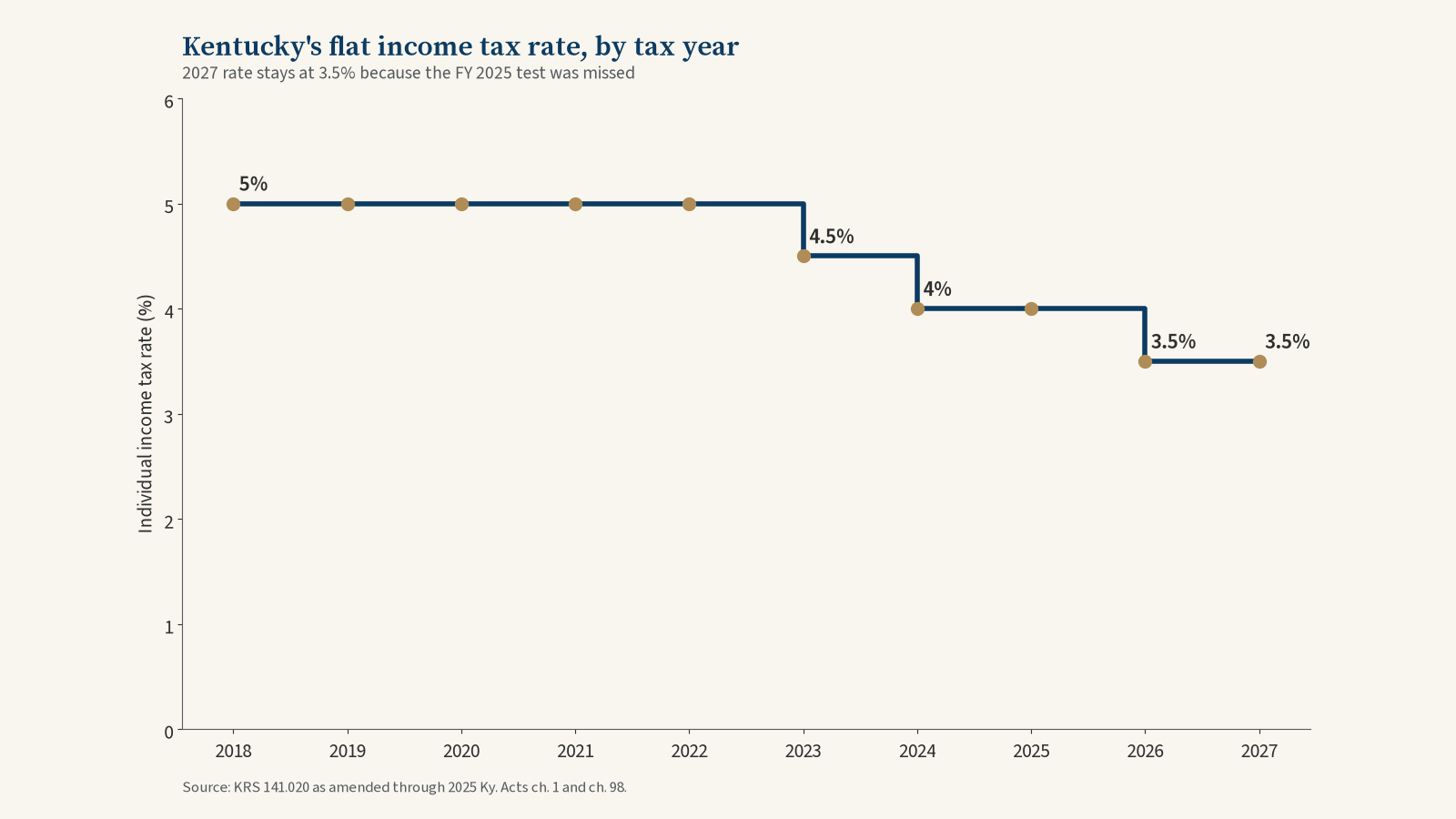
The rate itself has moved in steps. It was 5 percent from 2018 through 2022, then 4.5 percent in 2023, 4 percent in 2024 and 2025, and 3.5 percent from 2026.
What changed in 2025, and why didn’t it help?
A 2025 law added a smaller step: a quarter point cut if revenue clears appropriations plus more than half of the IIT equivalent. Fiscal 2026 was the first year it applied, and revenue missed that bar too.
The 2025 amendments to KRS 141.020 created a sliding scale. For the fiscal 2026 and fiscal 2027 tests, a cushion between 50 and 100 percent of the IIT equivalent allows a 0.25 point cut. From the fiscal 2028 test onward, the statute sets five bands, from a 0.1 point cut at 20 to 39 percent of the IIT equivalent up to the full 0.5 point cut at 100 percent.
That change came too late for fiscal 2025. Had it applied then, the $7.6 million miss would have qualified for the smaller step, as Kentucky Public Radio noted in its report.
In fiscal 2026, the cushion was only about 19 percent of the IIT equivalent, by the Institute’s calculation from the letter. That is below the 50 percent bar that applies this year, and it would also fall short of the lowest band that takes effect with the fiscal 2028 test.
What does this mean for the 2027 session?
The trigger statute gives lawmakers no authority to lower the rate for 2028 based on this test. Any cut for 2028 would require changing the law itself.
The 2027 General Assembly convenes on January 5, 2027, for a session of up to 30 legislative days. In odd numbered years, the Kentucky Constitution requires a three fifths majority of the members elected to each chamber for any bill that raises revenue or appropriates funds.
Lawmakers have shown little appetite for abandoning the trigger. Senate budget chair Chris McDaniel told Kentucky Public Radio that the result “definitely demonstrates the responsibility and the reactiveness of the model we have set up.” Two 2026 House bills that would have replaced the flat rate with graduated rates and repealed the trigger process, House Bill 13 and House Bill 152, were referred to the Appropriations and Revenue Committee and did not advance.
The next test covers the current fiscal year, which ends June 30, 2027. The budget director must report on it by September 5, 2027, under the statute. If it is met, the 2028 General Assembly could act on a cut for the 2029 tax year.
What should readers watch?
Three numbers: General Fund receipts, the size of appropriations as the statute defines them, and the rainy day fund balance.
- Monthly General Fund receipts, reported by the Office of State Budget Director, show whether revenue is closing any of the gap.
- Appropriations decisions in the 2027 session will move the other side of the test, because the threshold is built on them.
- The Budget Reserve Trust Fund balance, as the letters report it, fell from about $4.81 billion at the end of fiscal 2025 to about $4.16 billion at the end of fiscal 2026. It remains well above the 10 percent floor.
The Institute will publish a policy brief, How Kentucky’s Income Tax Trigger Works, on October 27. It sets out the full mechanics of the statute and the options before lawmakers, without taking a position on them.
For how the Ledger handles figures like these, see our opening note. For the Institute’s wider agenda on public finance, see the Center for Government and Civic Institutions.
Read the policy brief when it is released
The Institute’s step by step guide to the income tax trigger will be sent to subscribers first.
Sources
- Office of State Budget Director, Individual Income Tax Rate Reduction Conditions, Fiscal Year 2026, letter of September 4, 2026
- Office of State Budget Director, Individual Income Tax Rate Reduction Conditions, Fiscal Year 2025, letter of August 15, 2025
- Office of State Budget Director, Fiscal Year 2024 letter and Fiscal Year 2023 letter
- Kentucky Revised Statutes, KRS 141.020, effective June 27, 2025
- Joe Sonka, Kentucky Public Radio, Kentucky misses budget trigger for income tax cut by more than $1 billion, September 4, 2026
- Legislative Research Commission, 26RS House Bill 152 and 26RS House Bill 13
- Kentucky Constitution, Section 36