
01
Economic Growth & Competitiveness
Business investment, entrepreneurship, productivity, wages, and the conditions that keep Kentucky competitive over the long run.
An independent institute for Kentucky’s future
Kentucky’s hardest questions need independent research, sound evidence, and honest debate before they need more opinion.
The Commonwealth Initiative studies the economic, social, and institutional challenges facing the state and publishes what it finds. We are based in Louisville and work on behalf of all 120 counties.
Explore Our Research About the Initiative
Research. Policy. Progress.
Commonwealth of Kentucky120 counties
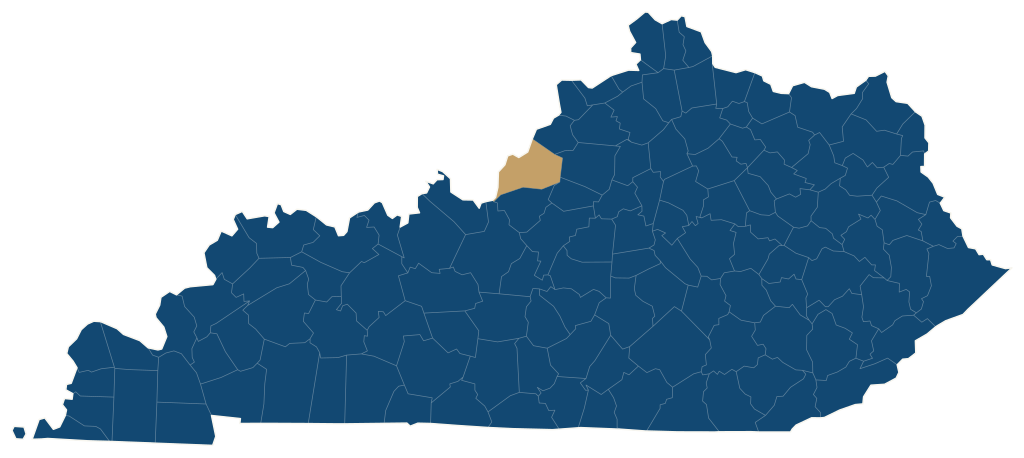
Jefferson County, home of the InstituteLouisville
Our purpose
The Commonwealth Initiative was founded on a plain conviction: the quality of Kentucky’s future depends in part on the quality of the ideas that inform its decisions.
Issues that are usually debated one at a time are closely tied together. Housing decides who can reach a job. Schooling decides who can move up. Infrastructure influences where employers invest. And whether a promising policy works at all depends on the public institutions that have to carry it out.
Kentucky benefits from having an independent place devoted to understanding those connections. We examine hard problems without ideological shortcuts and weigh competing approaches honestly. The work of government, universities, businesses, and community organizations remains theirs. Ours is to give all of them firmer common ground to decide on.
Areas of inquiry
No single issue explains Kentucky’s prospects. Our six research centers cover the economic, social, physical, and institutional systems that shape opportunity across the state, and they are organized to work together.
01
Business investment, entrepreneurship, productivity, wages, and the conditions that keep Kentucky competitive over the long run.
02
Housing supply and cost, land use, homeownership, homelessness, neighborhood change, and how place affects economic opportunity.
03
How Kentucky educates, trains, attracts, and keeps the people its employers and communities will depend on.
04
Health, poverty, family stability, and public services, and how each affects the ability of people and communities to do well.
05
Transportation, energy, broadband, water, and the technologies, artificial intelligence among them, that are changing how these systems work.
06
Public-sector performance, fiscal responsibility, accountability, and the capacity of state and local government to serve the public.
Kentucky in context
Good policy starts with an accurate picture of where the state stands. The three figures below come from public agencies. We show where each one comes from, when it was measured, and what it can and cannot tell you.
206,207
Modeled estimate, 2024.
Source: Kentucky Housing Corporation and Bowen National Research, Kentucky Housing Supply Gap Analysis, April 2024
The estimate is made up of 101,569 rental units and 104,638 for-sale units across all 120 counties. It measures the additional homes Kentucky households were estimated to need in 2024. It is not a count of missing or vacant buildings.
4.6%
Survey-based estimate, 2025 annual average, based on 11 months of data.
Source: Kentucky Center for Statistics (KYSTATS), release of April 9, 2026
A lapse in federal appropriations meant the Current Population Survey was not collected in October 2025. The 2025 average therefore rests on eleven months of data and is not strictly comparable with annual averages for earlier years. The national rate for the same period was 4.3 percent.
120
Count, current.
Source: U.S. Census Bureau, cartographic boundary files
These figures are a starting point. Behind each one are regional differences, families, employers, and public bodies making hard choices. Our job is to connect the numbers to the questions that matter and to separate what the evidence establishes from what is still uncertain. The Institute did not calculate these statistics.
Research and analysis
Our agenda covers the questions that will shape Kentucky’s next generation, from economic competitiveness and affordable housing to schools, infrastructure, and the effectiveness of government.
Research library
Analysis and commentary
Rooted in Louisville
Louisville holds a particular place in Kentucky’s economic and civic life. It is a center of commerce, health care, education, logistics, manufacturing, culture, and philanthropy.
It is also a place where many of the state’s most pressing policy questions can be seen up close and side by side: housing and economic mobility, neighborhood investment and public services, transportation and regional growth, schooling and the future of work.
None of these is confined to Louisville. The fact that they meet here makes the city a good starting point for research that matters statewide.
We are rooted in Louisville because place matters. Our mission reaches the whole state because no community’s future can be understood on its own. From the Ohio River to the Appalachian counties, from city neighborhoods to rural towns, we study Kentucky as one shared civic and economic undertaking.
The Commonwealth Agenda
Long-range thinking starts with the questions today’s decisions cannot afford to ignore. Each of ours belongs to one policy center.
How we work
Define the public question, establish its context, and examine the evidence already available.
Compare outcomes, test assumptions, identify limitations, and consider other explanations.
Bring informed people who disagree into the same discussion. Policy that lasts needs public understanding as well as evidence.
Publish the findings in accessible form, with policy options and the measures by which a decision can later be judged.
Hard questions rarely become simple. Our aim is to make them clearer, so that better decisions become possible.
Our commitment
Policy research is worth something only if readers can trust that the evidence was weighed fairly, that competing arguments were heard, and that the conclusion was not fixed in advance.
We are building an institute around intellectual independence, openness about methods, and care with evidence. When people disagree with our findings, we take that as a reason to check the claims again.
The Commonwealth Review
In development
The Commonwealth Review is our planned home for essays, interviews, and long-form writing on Kentucky’s economic and civic future. It will give careful arguments, and careful disagreement, the space they need.
Newsletter
New publications, public programs, and notes from The Commonwealth Ledger, sent when there is something worth reading.

We believe that independent thought, responsible institutions, and informed public decisions can help Kentucky realize more of its promise. The work will take years, and it belongs to everyone with a stake in the state.