

The Commonwealth Ledger is the place where The Commonwealth Initiative publishes shorter analysis, signed commentary, and verified news about Kentucky policy between its major studies. It opens with two pieces: an analysis of the state’s income tax trigger and the Institute’s first data note, on Kentucky’s 2025 unemployment rate.
This note explains what the Ledger is for, what it will and will not publish, and how readers can tell one kind of writing from another. That last point matters more than it might seem.
What is The Commonwealth Ledger?
The Ledger is the Institute’s running record of analysis and argument on Kentucky policy. It carries pieces by the Institute’s scholars and staff, plus the Institute’s own announcements.
A ledger is where accounts are kept and balanced. The name is meant to suggest the same habit applied to public questions: claims set against evidence, entry by entry, with the sources in view.
The Commonwealth Initiative is a nonpartisan public policy research institute based in Louisville. It studies the economic, social, and institutional questions facing Kentucky’s 120 counties through six policy centers, from economic growth to government and civic institutions.
Major studies take months. Public decisions do not always wait that long, and the Ledger is how the Institute can respond when a new number, a new law, or a new report changes the picture.
What will the Ledger publish?
Five kinds of entries, each labeled: analysis, commentary, policy perspectives, announcements, and events.
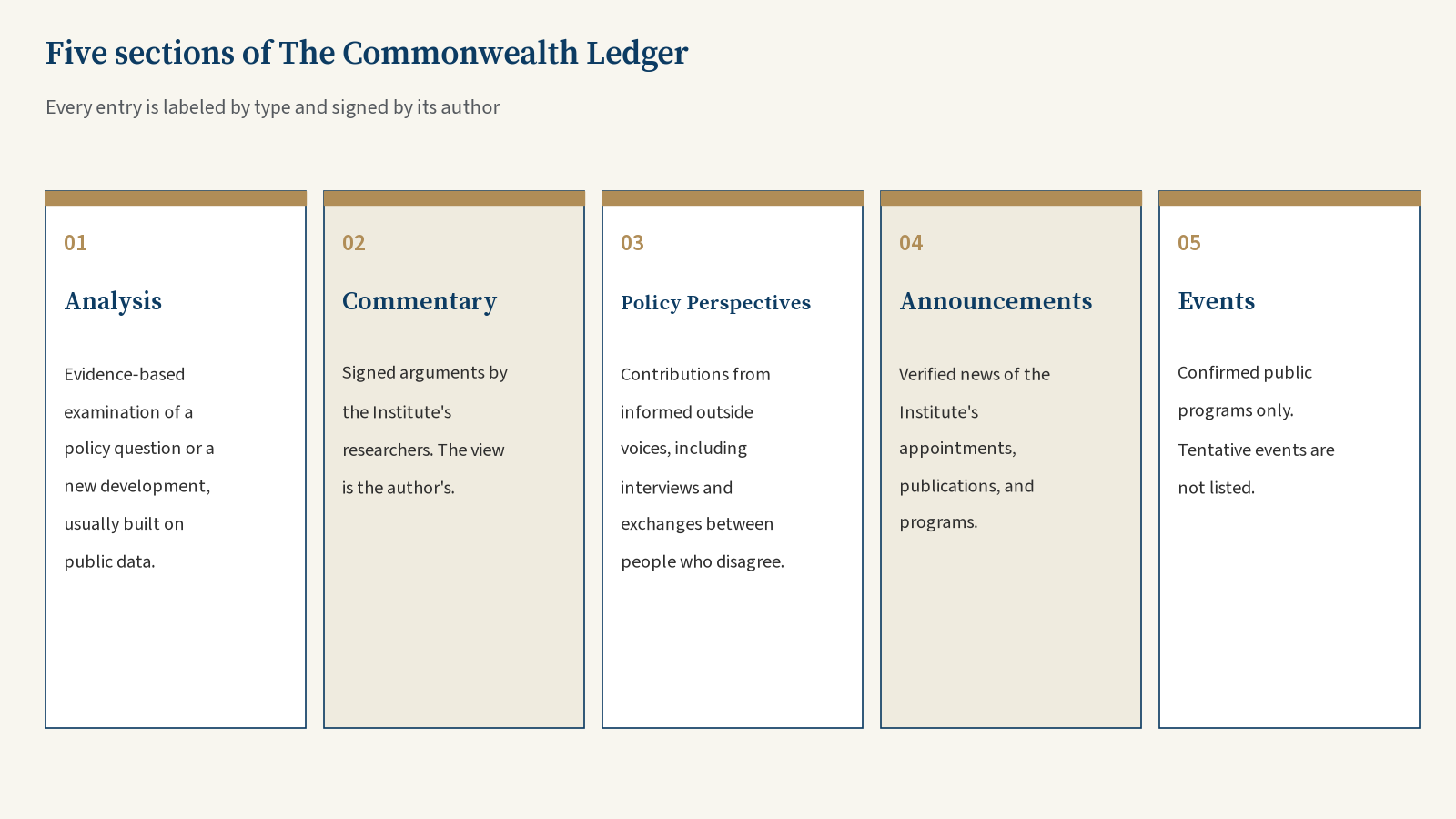
Analysis is the core of the Ledger. An analysis piece examines a policy question or a new development, usually with public data, and says plainly what the evidence shows and what it does not. The first analysis, on why Kentucky missed its income tax trigger again this year, is a good example of the form: it starts from the state budget director’s own figures and works outward.
Commentary is a signed argument by one of the Institute’s researchers. It is the author’s view. It is not a position of the Institute, and it will say so.
Policy Perspectives will carry informed outside voices, including interviews and exchanges between people who disagree. Nothing has been scheduled for this section yet.
Announcements report the Institute’s own news: appointments, new publications, and programs. This note is the first.
Events lists public programs only after they are confirmed. The Institute does not list tentative events.
What will the Ledger not publish?
Unsourced numbers, unsigned opinion, and anything presented as more certain than it is.
A few rules follow from the Institute’s standards and apply to every entry:
- No figure appears without its source and its period.
- No commentary is presented as research, and no research finding is presented as the Institute’s position on a pending bill.
- No event is listed until it is confirmed.
- No quotation appears unless it was said or written by the person named, in the place cited.
When a piece gets something wrong, the fix is made on the page and noted there, so readers can see what changed.
How is the Ledger different from the Institute’s research?
Research publications go through the Institute’s research process and appear in the research library. Ledger pieces are shorter, faster, and signed, and they are labeled so readers never have to guess which they are reading.
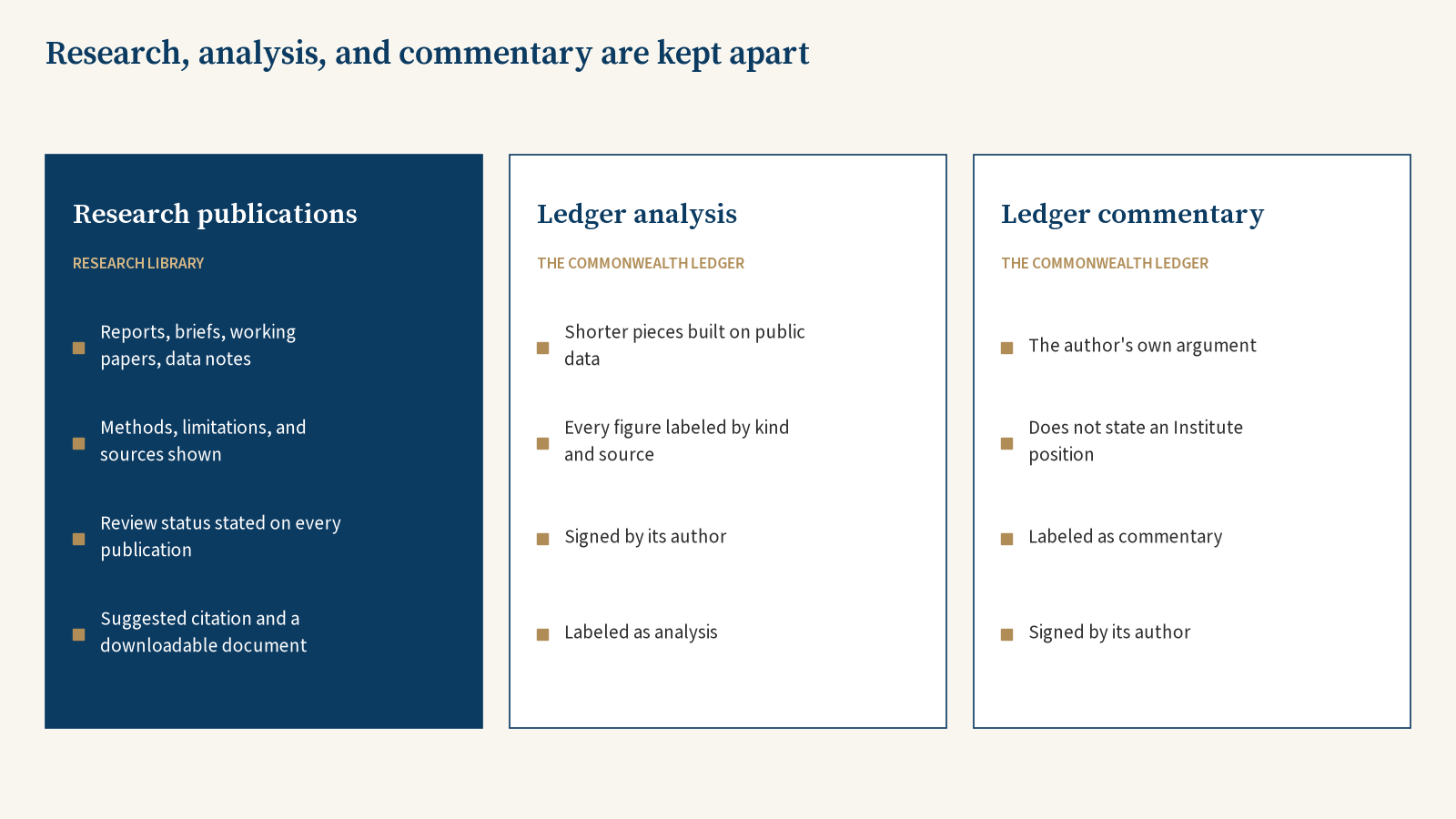
The Institute’s research methodology sets out what every research publication must show: named authors, the date of publication and of any revision, full sources, a description of methods, the limitations the authors see, funding and disclosures, the kind of review the work received, and a suggested citation.
Those are proposed standards. The Institute has said publicly that they await formal adoption by its Board of Directors, and the Ledger will not describe them as anything more settled than that.
The Ledger borrows the parts of that discipline that fit shorter work. Every figure names its source and its period.
Every piece says whether a number is a count, a survey estimate, a modeled estimate, or a projection. And every entry is signed.
What has been published so far?
Two pieces: a Ledger analysis of the income tax trigger and the Institute’s first data note.
The analysis, Kentucky Income Tax Trigger Missed by $1.2 Billion, works through the September 4, 2026 letter from the state budget director that found Kentucky’s revenue fell short of both thresholds needed to cut the income tax rate for 2028.
The data note, Kentucky Unemployment Rate 2025: The Missing Month, explains why the state’s published 2025 unemployment rate of 4.6 percent rests on eleven months of survey data rather than twelve. Data notes are short by design. Each one takes a single indicator, defines it exactly, gives its source and release date, and says what can and cannot be compared.
What is coming next?
Four more analyses over the next two weeks, then a policy brief on the income tax trigger.
The schedule below is set. Each piece will appear on the morning listed.
| Date | Section | Subject |
|---|---|---|
| Tuesday, October 13 | Analysis | Kentucky’s housing supply gap and what the 206,207 unit estimate measures |
| Thursday, October 15 | Analysis | Where Kentucky’s federal broadband money stands under the revised BEAD program |
| Tuesday, October 20 | Analysis | Kentucky’s labor force participation rate and how it compares with the nation |
| Thursday, October 22 | Analysis | How the 30 day 2027 session of the General Assembly works |
| Tuesday, October 27 | Policy brief | How Kentucky’s income tax trigger works, step by step |
Each of these subjects connects to a question on the Institute’s research priorities. Housing bears on who can take a job.
Broadband bears on where employers invest. And whether any policy works depends on the public institutions that carry it out, which is why the General Assembly explainer belongs on the list.
Who writes for the Ledger?
The first pieces are written by Bert Foster, a Commonwealth Governance and Policy Fellow at the Institute. His fellowship focuses on governance, public policy, and institutional effectiveness. Other authors will be named on their pieces as they publish.
Every entry carries its author’s name. Analysis is the author’s reading of the evidence, written to the Institute’s standards for sourcing. Commentary is the author’s own argument.
How can readers check our work?
Follow the sources. Each Ledger piece ends with a list of the documents it relies on, linked where they are online. Where the Institute has calculated something itself from published figures, the piece says so.
If you find an error, use the Institute’s contact page, choose “Research inquiry,” and name the page. A correction will be made on the page itself.
The Institute’s commitments on independence, review, conflicts of interest, and funding disclosure are set out on its research independence page, also as proposed standards awaiting board adoption.
Why start now?
Because the questions are already in front of Kentucky. The 2027 General Assembly convenes on January 5.
The state’s housing, broadband, and workforce numbers are moving. A reader who wants to understand them should not have to wait for a 100 page report.
The Ledger will not cover everything. It will try to cover a few things carefully, show its sources, and say plainly when the evidence runs out.
Get the Ledger by email
New analysis and research from The Commonwealth Initiative, sent when it is published.
Sources
- The Commonwealth Initiative, Insights: The Commonwealth Ledger
- The Commonwealth Initiative, Research Methodology
- The Commonwealth Initiative, Research Independence
- The Commonwealth Initiative, Research Priorities
- Legislative Research Commission, 2027 Regular Session Calendar